
Family navigation services
family navigation services
When Someone You Love Dies — and the System Leaves You in the Dark
When a death occurs unexpectedly, families are immediately drawn into a system they have never encountered—one with its own language, processes, timelines, and institutional cultures. Agencies operate in parallel with minimal coordination and even less explanation. No one is assigned the task of helping a family understand what is happening or why.
Attorneys represent legal interests. Victim advocates address emotional needs. Until now, no independent, structured service has existed to interpret and navigate the medicolegal death investigation system for families. No one explained the process.
Families face all the following simultaneously:
• Multiple agencies with overlapping but distinct jurisdictions (medical examiner or coroner, law enforcement, hospital, prosecutor’s office).
• Technical processes—autopsy, toxicology, scene investigation, cause and manner determination—that are opaque even to educated lay people.
• Significant variation in communication norms: some offices proactively update families; many do not.
• Timelines that stretch weeks or months, with no map and no explanation for delays.
• High emotional load paired with low informational clarity—a combination that produces anxiety, misinformation, and avoidable conflict with agencies.
Family Navigation Services (FNS) is a structured, non-legal, non-medical advisory service that helps families understand, navigate, and engage with medicolegal death investigation processes.
The service rests on three operational pillars:
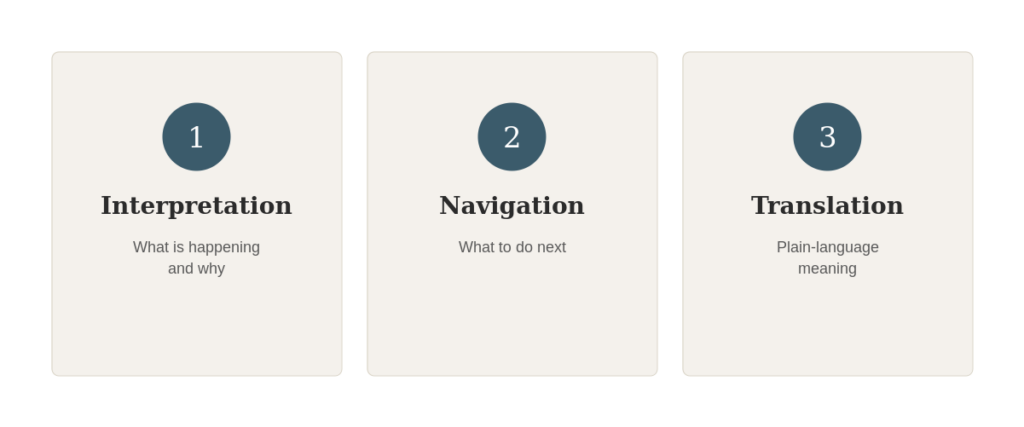
Primary Clients — Families
FNS is designed for families who have experienced an unexpected, traumatic, or medically complex death and find themselves navigating investigation processes without a guide. These are not grief clients. They are information clients who need a structured, authoritative interpreter.
Families I serve are typically attempting to navigate the following death situations:
• Death is recent, and the investigation is active or recently concluded.
• Sudden or unexpected death— overwhelmed by the process, needing a knowledgeable guide through what the system is doing, what the documents mean, and what to expect next.
• In-custody or law-enforcement-related death. — a death that occurred in a jail, detention facility, or during law enforcement contact. These cases involve the most complex intersection of systems, and families are almost always left without any coordinated explanation of what is happening or what their rights are.
• Cause or manner of death is pending, contested, or not yet explained in plain language — when a cause or manner of death does not match what the family knows or expected, and no one will explain the basis for the determination or what options exist.
In addition:
• Family has received minimal or inconsistent communication from investigating agencies, or
• Family is engaged with the process and wants to understand it—not simply receive a final answer, and
• Family has resources to engage professional advisory services (or is connected to an organization that can provide access)
Secondary Clients — Professional Advisory
FNS also serves professionals who need an independent expert to interpret medicolegal systems, identify process deviations, or provide analytical support for legal, journalistic, or advocacy work.
• Attorneys: plaintiff’s counsel in wrongful death cases, civil rights litigation, insurance disputes
• Journalists: investigative reporters covering in-custody deaths, medical examiner office dysfunction, public health stories
• Advocacy organizations: families’ rights groups, oversight entities, reform organizations
• Institutions: hospitals, risk management departments, peer review bodies needing external process assessment
the process
Each engagement begins with an intake consultation. I listen to your situation, explain the relevant processes, and provide you with a written summary and recommended next steps. From there, I can work with you as much or as little as your circumstances require.
Intake Consultation
A structured 60–90-minute consultation — by phone or video — in which I review your situation, explain the relevant processes and systems involved, and identify the questions you should be asking and the records you should be requesting. You receive a written summary of our conversation and a clear outline of recommended next steps. Flat fee — you know the cost before we begin.
Ongoing Navigation Consulting
For families who need continued support, I am available on an hourly basis to review documents, help formulate questions for the ME’s office or the investigating agency, advise on records requests, and guide you through each stage of the process as it unfolds.
Document Review and Interpretation
Medical examiner/coroner investigative reports. Autopsy reports. Toxicology reports. Law enforcement reports. Medical records. Death certificates. These are technical documents. I read them with you, explain what they say, identify what questions they raise, and help you understand whether what you have been given tells the full story.
Records Request Assistance
I help you identify what records exist, who holds them, what your legal right of access is, and how to submit an effective request. I know where agencies create bureaucratic friction — and how to navigate it.
Referral and Coordination
When you need an attorney, I know who handles these cases. When you need additional forensic expertise, I understand that landscape. I do not replace other professionals — I help you find the right ones at the right time and help you arrive prepared.
important note
I am a death investigation consultant — not an attorney or a therapist. I do not provide legal advice or mental health services. What I provide is professional expertise on process, systems, and records: the knowledge that helps you ask better questions, understand the answers, and make informed decisions about your next steps.
I do not provide:
• Legal advice. FNS does not advise on legal strategy, rights, or remedies. Clients with legal questions are directed to attorneys.
• Medical determinations. FNS does not challenge, verify, or render opinions on cause or manner of death. That is the jurisdiction of credentialed forensic pathologists.
• Representation. FNS does not represent clients before agencies, at hearings, or in formal proceedings.
• Advocacy. FNS informs and guides; it does not campaign on behalf of clients or pursue outcomes.
• Emotional support services. FNS is not a counseling or grief support service. Clients needing therapeutic support are referred to appropriate professionals.
fees
A signed engagement letter and retainer are required before work begins. Full fee schedule available upon request. All inquiries are confidential.
ready to talk?
If you are navigating the aftermath of a loss and you need someone who understands the system to help you through it, I am here. The first step is a conversation — confidential, no obligation, and on your timeline. Schedule a consultation below or contact me directly at Paul@PaulRParker.com or 619-455-7228.
Inquire
Inquire Now

Join
My Mailing List
Sign up to my newsletter for all the latest news and updates!